Is the UN worth saving?
Janet Epp Buckingham, who speaks for Christians at the UN in Geneva, explains why her answer is yes
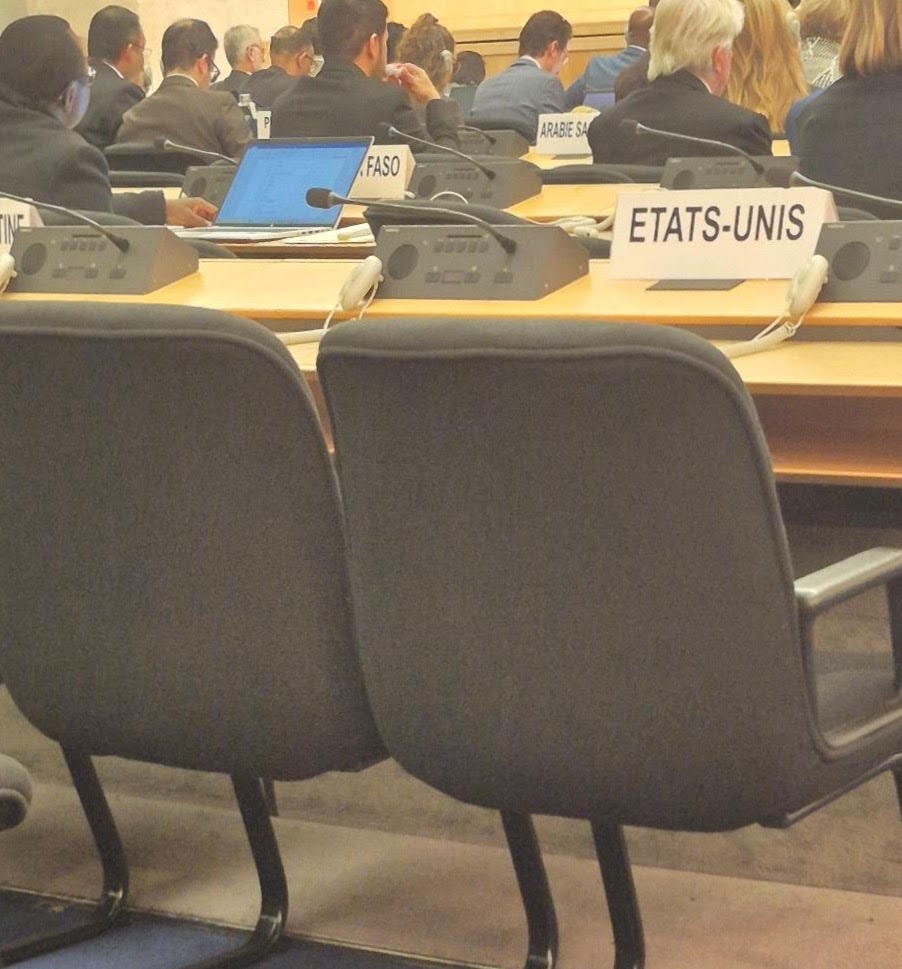
The United States chair sat unoccupied during this recent UN Human Rights Council session on Iran. Source: Markus Hofer.
Last week, UN Secretary General Antonio Guterres announced that the UN could run out of money by July. The main reason is that the United States has virtually ended its contributions. From the UN’s perspective, the US owes the UN more than $2 billion for its regular budget and more than $4.5 billion if one includes peacekeeping mission costs.
But the UN is not likely to receive that money from the current US administration. In fact, seemingly not satisfied to control just one country, Donald Trump may be scheming to rule the world by undermining the UN with his competing “Board of Peace“ initiative, which has given him the title of permanent chairman.
If the UN stays afloat by finding contributions elsewhere, that would reinforce the sense among US conservatives that US taxpayer money can be used in better ways than by making financial contributions to a global organization they don’t like.
On the other hand, if the US doesn’t pay, the UN could hit back by terminating US membership, as every country in the world is expected to make contributions in an amount based on their gross national product.
There are certainly reasons for dissatisfaction with the UN. Its Security Council and its human rights efforts are shackled by the veto power of its permanent members. Some of its activities, in such areas as family planning and children’s rights, are disliked by many Christians.
What should Christians support at this time of global crisis and dissipation of alliances unlike anything the free world has experienced since the formation of the UN 80 years ago? I asked Janet Epp Buckingham, who represents the World Evangelical Alliance at the UN Human Rights Council in Geneva, to share her thoughts.
Since December 2025, more than 80,000 refugees have crossed from the Democratic Republic of the Congo into Burundi. Burundi is the second-poorest country in the world. Yet within days, refugee camps were established. Latrines were dug. Tents were raised. Food began to flow.
Who showed up? The United Nations High Commissioner for Refugees (UNHCR) and its partners.
Yes, the United Nations.
“But didn’t a peace agreement get signed between the DRC and Rwanda?” some ask. “Why are there still refugees?”
Because signing a peace agreement does not, by itself, create peace.
Peace is not a signature on paper. It is a long, fragile process. Ceasefires must be monitored. Armed groups must be disarmed and demobilized. Political systems must be rebuilt. The rule of law must be restored. Refugees must be helped home. Communities must relearn how to live without fear.
This is the slow, unglamorous work the UN was designed to do.
On December 26, 2025, the U.S. military carried out airstrikes on key Islamic State bases in Nigeria. Christians and others who had been driven from their lands rejoiced. It felt like the first step toward freedom from escalating violence.
But airstrikes are not peacebuilding.
The United States does not have the infrastructure—or the mandate—to undertake the long, layered work of rebuilding civil society, restoring governance, and supporting reconciliation in multiple conflict zones at once.
The UN does.
Just weeks ago in Davos, Canadian prime minister Mark Carney received a standing ovation for naming what many have sensed but few have said plainly. He stated, “The multilateral institutions on which the middle powers have relied—the [World Trade Organization], the UN, the COP [Conference of the Parties on climate change]—the architecture, the very architecture of collective problem solving—are under threat.”
Carney added, “We are in the midst of a rupture, not a transition.”
Those of us who work closely with the United Nations have been watching this rupture unfold in real time.
Since September 2024, I have been based in Geneva, representing the global constituency of the World Evangelical Alliance to various UN agencies, primarily the Human Rights Council. In the past 18 months, I have watched many UN staff lose their jobs. Those who remain often carry the workload that once belonged to three or four people. They are stretched thin and under immense strain.
Geneva is also home to organizations that coordinate global efforts on intellectual property, meteorology, trade, health, aviation, shipping, and digital technology. These are not abstract concerns. They are the invisible systems that make our interconnected world function.
Now the Secretary-General has warned that the UN could run out of money as early as July.
Some people hear this news and say, “Good riddance.”
I am not one of them.
We live in a deeply interconnected world. COVID-19 revealed how quickly a virus travels across borders. It also exposed how tightly woven our global supply chains are. Many will remember when people began stockpiling toilet paper because of rumors that stores would run out.
Global problems require global coordination. That coordination often happens through UN bodies such as the World Health Organization (WHO), the International Civil Aviation Organization (ICAO), and the International Maritime Organization (IMO). These organizations help ensure that planes can land safely across borders, ships can navigate international waters, and countries can share critical health information in real time.
These are not small things. They are part of the fabric of everyday life, things most of us take for granted.
Last year marked the 80th anniversary of the UN Charter. The world of 2025 looks very different from the world of 1945. The Secretary-General has initiated reform efforts, but persuading 193 member states to agree on what those reforms should be is no small task.
Born from the ashes of war, the UN’s most visible work still centers on peace. The Security Council was designed as the primary mechanism to prevent and respond to conflict. Its structure—with five permanent members holding veto power—has long been a source of frustration. The US, Russia, and China use their vetoes frequently; the UK and France have not used theirs since the end of the Cold War.
Would the Security Council function more effectively without vetoes? I would support this option. I am not in favor of a new mechanism where one country has a veto but no one else.
Thousands of civil society organizations have UN consultative status, allowing them to address the Human Rights Council directly and call nations to account. For many communities, this is the only international platform where their voices can be heard.
Madeleine Albright once said, “If the United Nations didn’t exist, we would have to invent it.”
We need a place where nations—large and small—sit together to address the world’s most pressing issues. We need a place where countries can be called to account. We need coordinated action on matters as mundane as airport codes and as vital as peacekeeping.
Over the past year, the United States has withdrawn from multiple UN agencies, including the WHO and the Human Rights Council. The stated rationale is that these institutions do not adequately serve American interests. Rather than pursuing reform from within, the US has chosen to disengage.
In the absence of one major power, others step in. As the US has withdrawn, other global powers have been ready to fill the vacuum—reshaping priorities and staffing accordingly.
The world order is being reshaped in real time. The US began from a position of strength, but now new alliances are forming quietly, often without US participation.
For Christians, this conversation is not merely political. It is deeply theological.
We believe in a God who cares about justice, peace, dignity, and the protection of the vulnerable (see Psalm 146). We follow a Savior who crossed boundaries and broke down walls (see John 4:4–42). We are called to be peacemakers in a fractured world (Matthew 5:9).
The UN is imperfect, bureaucratic, and often frustrating. It reflects the brokenness of the nations that compose it. But it is does important work around the world, work that requires long-term commitment. Let’s look for ways to reform it rather than rejecting it.
Thank you, Bruce, for this constructive post. DJT's implementation of his transactional, competitive, and self-serving version of "America First" is bearing all sorts of negative consequences internationally. Agreed with several good points in Robert Osburn's earlier post as well.
I think she makes a good case for the UN and, by implication, for the US to stay involved. As a conservative, I certainly do have significant reservations, as the corruption within the UN has bene undeniable. But, we need it, and we should be involved and make our contributions on the condition that the organization makes major changes in the way it operates. I do not have a prescription for what those changes should be, but those working near the center of that organization should heartily work to reform it while keeping the US engaged and involved. By the way, I make one final observation: The incentivization strategy (as per the the UN dues being a percentage of GDP) is flawed. This approach, in its own way, disincentives development and increasing GDP. As part of the reform, there needs to be a new formula for UN dues.